Production allocation efficiency
from hos import *Model Parameters
The model uses these parameters (defined in hos.py):
= 0.6: Capital share in agriculture (sector A)
= 0.4: Capital share in manufacturing (sector M)
= 100: Total capital endowment
= 100: Total labor endowment
Since , agriculture is relatively capital-intensive compared to manufacturing.
from hos import *
Efficiency in production
Consider a small-open economy with two production sectors -- agriculture and manufacturing -- with production in each sector taking place with constant returns to scale production functions. Producers in the agricultural sector maximize profits
Producers in manufacturing maximize
In equilibrium total factor demands must equal total supplies:
The first order necessary conditions for an interior optimum in each sector lead to an equilibrium where the following condition must hold:
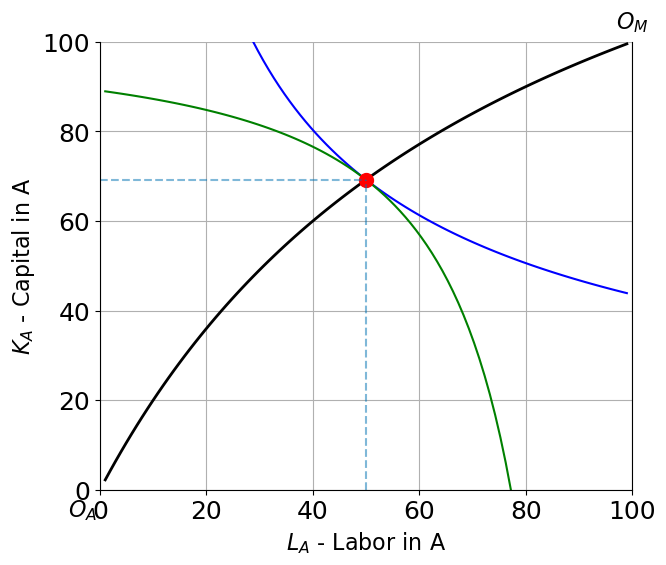
Efficiency requires that the marginal rates of technical substitution (MRTS) be equalized across sectors (and across firms within a sector which is being assumed here). In an Edgeworth box, isoquants from each sector will be tangent to a common wage-rental ratio line.
If we assume Cobb-Douglas forms and the efficiency condition can be used to find a closed form solution for in terms of :
Here is an Edgeworth Box depicting the situation where units of labor are allocated to the agricultural sector and all other allocations are efficient (along the efficiency locus).
Edgeworth Box plots
edgeplot(50)(LA, KA) = (50.0, 69.2) (QA, QM) = (60.8, 41.2) RTS = 2.1
The Production Possibility Frontier
The efficiency locus also allows us to trace out the production possibility frontier: by varying from 0 to and, for every , calculating and with that efficient production where and .
The curvature of the PPF depends on how different the factor intensities are:
When (similar factor intensities): PPF is nearly straight
When or (very different intensities): PPF is more curved
For Cobb-Douglas technologies the PPF will be quite straight unless and are very different from each other. In practical terms, this means that quite small changes to product prices will move production around quite a bit when factor intensities are similar.
ppf(30, alpha=0.9, beta=0.1)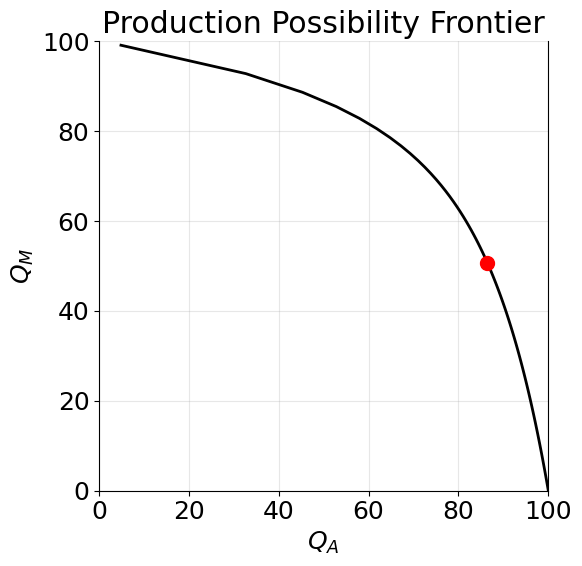
Jump to the notebook on the Heckscher
If you’re reading this using a jupyter server you can interact with the following plot, changing the technology parameters and position of the isoquant. If you are not this may appear blank or static.
LA = 50
interact(edgeplot, LA=(10, Lbar-10,1),
         Kbar=fixed(Kbar), Lbar=fixed(Lbar),
alpha=(0.1,0.9,0.1),beta=(0.1,0.9,0.1));The Production Possiblity Frontier
The efficiency locus also allows us to trace out the production possibility frontier: by varying from 0 to and, for every , calculating and with that efficient production where and .
For Cobb-Douglas technologies the PPF will be quite straight unless and are very different from each other! (In practical terms what this means is that quite small changes to product prices will move around production quite a bit)
ppf(30,alpha =0.9, beta=0.1)Jump to the notebook on the Hecksher